With the standards definitions now available for LTE, the Long Term
Evolution of the 3G services, eyes are now turning towards the next
development, that of the truly 4G technology named IMT Advanced. The new
technology being developed under the auspices of 3GPP to meet these
requirements is often termed LTE Advanced.
In order that the cellular telecommunications technology is able to
keep pace with technologies that may compete, it is necessary to ensure
that new cellular technologies are being formulated and developed. This
is the reasoning behind starting the development of the new LTE Advanced
systems, proving the technology and developing the LTE Advanced
standards.
In order that the correct solution is adopted for the 4G system, the
ITU-R (International Telecommunications Union - Radiocommunications
sector) has started its evaluation process to develop the
recommendations for the terrestrial components of the IMT Advanced radio
interface. One of the main competitors for this is the LTE Advanced
solution.
One of the key milestones is October 2010 when the ITU-R decides the
framework and key characteristics for the IMT Advanced standard. Before
this, the ITU-R will undertake the evaluation of the various proposed
radio interface technologies of which LTE Advanced is a major contender.
Key milestones for ITU-R IMT Advanced evaluation
The ITU-R has set a number of milestones to ensure that the
evaluation of IMT Advanced technologies occurs in a timely fashion. A
summary of the main milestones is given below and this defines many of
the overall timescales for the development of IMT Advanced and in this
case LTE Advanced as one of the main technologies to be evaluated.
| Key Milestones on the Development of 4G LTE-Advanced |
| Milestone |
Date |
| Issue invitation to propose Radio Interface Technologies. |
March 2008 |
| ITU date for cut-off for submission of proposed Radio Interface Technologies. |
October 2009 |
| Cutoff date for evaluation report to ITU. |
June 2010 |
| Decision on framework of key characteristics of IMT Advanced Radio Interface Technologies. |
October 2010 |
| Completion of development of radio interface specification recommendations. |
February 2011 |
LTE Advanced development history
With 3G technology established, it was obvious that the rate of
development of cellular technology should not slow. As a result initial
ideas for the development of a new 4G system started to be investigated.
In one early investigation which took place on 25 December 2006 with
information released to the press on 9 February 2007, NTT DoCoMo
detailed information about trials in which they were able to send data
at speeds up to approximately 5 Gbit/s in the downlink within a 100MHz
bandwidth to a mobile station moving at 10km/h. The scheme used several
technologies to achieve this including variable spreading factor spread
orthogonal frequency division multiplex, MIMO, multiple input multiple
output, and maximum likelihood detection. Details of these new 4G trials
were passed to 3GPP for their consideration
In 2008 3GPP held two workshops on IMT Advanced, where the
"Requirements for Further Advancements for E-UTRA" were gathered. The
resulting Technical Report 36.913 was then published in June 2008 and
submitted to the ITU-R defining the LTE-Advanced system as their
proposal for IMT-Advanced.
The development of LTE Advanced / IMT Advanced can be seen to follow
and evolution from the 3G services that were developed using UMTS /
W-CDMA technology.
| Comparison of LTE-A with other Cellular Technologies |
| |
WCDMA
(UMTS) |
HSPA
HSDPA / HSUPA |
HSPA+ |
LTE |
LTE Advanced
(IMT Advanced) |
Max downlink speed
bps |
384 k |
14 M |
28 M |
100M |
1G |
Max uplink speed
bps |
128 k |
5.7 M |
11 M |
50 M |
500 M |
Latency
round trip time
approx |
150 ms |
100 ms |
50ms (max) |
~10 ms |
less than 5 ms |
| 3GPP releases |
Rel 99/4 |
Rel 5 / 6 |
Rel 7 |
Rel 8 |
Rel 10 |
| Approx years of initial roll out |
2003 / 4 |
2005 / 6 HSDPA
2007 / 8 HSUPA |
2008 / 9 |
2009 / 10 |
2014 / 15 |
| Access methodology |
CDMA |
CDMA |
CDMA |
OFDMA / SC-FDMA |
OFDMA / SC-FDMA |
LTE Advanced is not the only candidate technology. WiMAX is also
there, offering very high data rates and high levels of mobility.
However it now seems less likely that WiMAX will be adopted as the 4G
technology, with LTE Advanced appearing to be better positioned.
LTE Advanced key features
With work starting on LTE Advanced, a number of key requirements and
key features are coming to light. Although not fixed yet in the
specifications, there are many high level aims for the new LTE Advanced
specification. These will need to be verified and much work remains to
be undertaken in the specifications before these are all fixed.
Currently some of the main headline aims for LTE Advanced can be seen
below:
- Peak data rates: downlink - 1 Gbps; uplink - 500 Mbps.
- Spectrum efficiency: 3 times greater than LTE.
- Peak spectrum efficiency: downlink - 30 bps/Hz; uplink - 15 bps/Hz.
- Spectrum use: the ability to support scalable bandwidth use and
spectrum aggregation where non-contiguous spectrum needs to be used.
- Latency: from Idle to Connected in less than 50 ms and then shorter than 5 ms one way for individual packet transmission.
- Cell edge user throughput to be twice that of LTE.
- Average user throughput to be 3 times that of LTE.
- Mobility: Same as that in LTE
- Compatibility: LTE Advanced shall be capable of interworking with LTE and 3GPP legacy systems.
These are many of the development aims for LTE Advanced. Their actual
figures and the actual implementation of them will need to be worked
out during the specification stage of the system.
LTE Advanced technologies
There are a number of key technologies that will enable LTE Advanced
to achieve the high data throughput rates that are required. MIMO and
OFDM are two of the base technologies that will be enablers. Along with
these there are a number of other techniques and technologies that will
be employed.
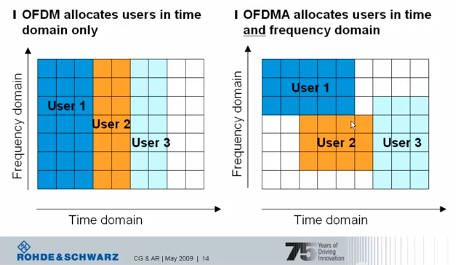
- Orthogonal Frequency Division Multiplex, OFDM
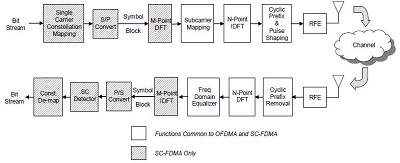
OFDM forms the basis of the radio bearer. Along with it there is OFDMA
(Orthogonal Frequency Division Multiple Access) along with SC-FDMA
(Single Channel Orthogonal Frequency Division Multiple Access). These
will be used in a hybrid format. However the basis for all of these
access schemes is OFDM.
Note on OFDM:
Orthogonal Frequency Division Multiplex (OFDM) is a form of
transmission that uses a large number of close spaced carriers that are
modulated with low rate data. Normally these signals would be expected
to interfere with each other, but by making the signals orthogonal to
each other there is no mutual interference. The data to be transmitted
is split across all the carriers to give resilience against selective
fading from multi-path effects..
Click on the link for an
OFDM tutorial
- Multiple Input Multiple Output, MIMO: One of the
other key enablers for LTE Advanced that is common to LTE is MIMO. This
scheme is also used by many other technologies including WiMAX and Wi-Fi
- 802.11n. MIMO - Multiple Input Multiple Output enables the data rates
achieved to be increased beyond what the basic radio bearer would
normally allow.
Note on MIMO:
Two major limitations in communications channels can be multipath
interference, and the data throughput limitations as a result of
Shannon's Law. MIMO provides a way of utilising the multiple signal
paths that exist between a transmitter and receiver to significantly
improve the data throughput available on a given channel with its
defined bandwidth. By using multiple antennas at the transmitter and
receiver along with some complex digital signal processing, MIMO
technology enables the system to set up multiple data streams on the
same channel, thereby increasing the data capacity of a channel.
Click on the link for a
MIMO tutorial
For LTE Advanced, the use of MIMO is likely to involve further and
more advanced techniques including the use of additional antennas in the
matrix to enable additional paths to be used, although as the number of
antennas increases, the overhead increases and the return per
additional path is less.
In additional to the numbers of antennas increasing, it is likely that
techniques such as beamforming may be used to enable the antenna
coverage to be focused where it is needed.
- Carrier Aggregation, CA: As many operators do not
have sufficient contiguous spectrum to provide the required bandwidths
for the very high data rates, a scheme known as carrier aggregation has
been developed. Using this technology operators are able to utilise
multiple channels either in the same bands or different areas of the
spectrum to provide the required bandwidth. Read more about Carrier Aggregation, CA
- Coordinated Multipoint : One of the key issues
with many cellular systems is that of poor performance at the cell
edges. Interference from adjacent cells along with poor signal quality
lead to a reduction in data rates. For LTE-Advanced a scheme known as
coordinated multipoint has been introduced. Read more about Coordinated Multipoint, CoMP
- LTE Relaying: LTE relaying is a scheme that
enables signals to be forwarded by remote stations from a main base
station to improve coverage. Read more about LTE Relaying
- Device to Device, D2D: LTE D2D is a facility that
has been requested by a number of users, in particular the emergency
services. It enables fast swift access via direct communication - a
facility that is essential for the emergency services when they may be
on the scene of an incident. Read more about Device to Device communications